

Pilates Cross-Training for Para Equestrians
Updated:
July 21, 2025By Sandra Verda-Zanatta, SVZ Dressage & F2R Fit To Ride Pilates for Equestrians
Although organized therapeutic riding programs emerged in the 1950s, the benefits of horseback riding for people’s physical and mental health were recognized as early as ancient Greece. The rhythmic motion of the horse’s walk replicates the human walk and promotes core strength, postural alignment, flexibility, balance, and normalized muscle tone. Learning to guide the horse with seat, arms, hands, and legs fosters fine motor skills and improves coordination. Along with the positive physical effects, the human-horse bond promotes mental and emotional well-being by reducing anxiety, encouraging independence, and building self-confidence.
In 1952, Lis Hartel, a Danish equestrian partially paralysed by polio, rehabilitated her body and reactivated her muscles through riding. Although still paralysed below the knees, she went on to win a silver medal at Helsinki Olympics. This accomplishment brought more awareness to the value and therapeutic benefits of horseback riding, and to the competitive aspect of equestrian sport for people with disabilities. Today, many competitive para equestrians start in therapeutic riding programs and eventually progress to become elite athletes competing internationally.
Related: Mounted Exercises to Improve a Horse Rider's Seat and Effectiveness
Another interesting fact that attests to the uniqueness of equestrian sports is that male and female athletes compete against each other on an even playing field. Additionally, dressage para equestrian athletes are eligible to compete in mainstream competitions with adaptive equipment if they are officially classified through their national organization and have a dispensation card authorizing adaptations.
Pilates cross-training is an effective modality for para equestrian athletes to improve physical and mental health, technical skills, and competitive performance. The total body strength, balance, flexibility, and coordination gained from focused exercises are key fitness factors required to excel in all levels of sport. This is especially true in equestrian sports as the rider’s body has a direct influence on the horse’s body.

Lis Hartel (1921–2009) was a Danish Olympic equestrian and the first woman to win a medal in individual dressage. At the 1952 Helsinki Olympics, she was one of the first women to compete in modern equestrian sports, earning a silver medal despite being paralyzed below the knees due to polio. She also won silver at the 1956 Olympics and multiple Danish dressage championships.
Born in Hellerup, Denmark, Hartel began riding young, coached by her mother and later by Olympic trainer Gunnar Andersen. Despite contracting polio in 1944 while pregnant with her second child, she resumed competing, achieving remarkable success. After retiring, Hartel promoted therapeutic riding and supported polio patients. Honoured in Denmark’s Hall of Fame in 1992, she remains a symbol of perseverance in sports history.
Related: Increased Mobility and Flexibility for Horse Riders
A rider’s position while mounted has a significant effect on the horse’s balance and ability to move with maximum ease and efficiency. Therefore, all riders should strive to develop their own best position. It is unrealistic to think that every rider is able to attain the often-referenced “ideal balanced position” of the plumb line: ear-shoulder-hip-heel. The true goal should be to develop the most balanced, symmetrical, and secure position possible to support positive training sessions and quality competitive performances. It’s about being creative, adapting equipment, and finding ways to promote effectiveness, comfort, and security.
In addition to the distinctive relationship between horses and riders that requires cooperation and synchronization of two sentient beings, there are unique challenges faced by para equestrians that require an innovative approach to adapt exercises and accommodate specific needs and abilities. Knowledge and understanding of the characteristics of different disabilities is imperative to adapt training techniques both on and off the horse, helping riders improve mobility, body strength, limb control, and balance.
Riders of all levels, disciplines, and ages can benefit from a personal cross-training plan. In general, rider fitness significantly contributes to performance, safety, and injury prevention. If we expect our horses to be athletes, we owe it to them to be accountable and committed to improving our own fitness. The reality is, we all have imbalances and asymmetries, weaknesses and strengths. The goal is to be subtle, yet effective, and in harmonious communication with our equine partners.
Effective communication, postural alignment, and balance while mounted can all be improved through specific exercises. Abdominal and upper back strength, along with shoulder girdle stability, help riders maintain posture and stay centered in the saddle. Flexibility and coordination enable clear, precise aids and fluid responses to the horse’s movements. Along with strength and flexibility training, cardiovascular fitness is also important for endurance during longer rides and multi-day competitions. These factors increase overall comfort for both athletes and contribute to the development of cohesive partnerships.
Specific disabilities can impact a rider’s ability in diverse ways, making it imperative to develop individualized programs and adapt exercises to each rider’s needs. Physical limitations and mobility impairments such as paralysis (loss of ability to move, and in some cases, feel part or all of the body); partial paresis (weakness of muscle groups caused by nerve damage); spastic or flaccid muscle tone; hypermobility or limited range of motion in joints; and vision or hearing loss can affect a rider’s ability to maintain balance, give clear cues, and move limbs fluidly.
Pilates exercises can be adapted by a knowledgeable professional and tailored to accommodate individual rider needs with a focus on comfort, safety, and efficiency. Seated exercises using resistance flex bands are effective to improve range of motion and limb strength while promoting fluid movement and elasticity. Pelvic tilts, side bends, and torso rotations improve mobility and encourage engagement of core muscles. Stability balls, balance boards, and wobble discs are useful to improve the dynamic balance needed while riding. Tack and equipment such as adapted saddles with pommel handles, oversized thigh blocks, deeper seats with higher cantles, adapted safety stirrups, and Velcro® straps are helpful to stabilize leg positions. Modified reins with loops and varied thicknesses help grip strength and promote consistent rein control and improved contact. These are just a sample of the vast number of inventive adaptations utilized by para equestrians to improve effectiveness and performance while ensuring comfort and safety.
The following exercises can be helpful for a wide variety of equestrians who are striving to improve total body strength, focusing on core engagement, coordination, balance, and the feeling of elasticity in the arms.
SEATED EXERCISES: CHAIR, STABILITY BALL, WOBBLE CUSHION

1. Posture Control with Flex Band
Sit on wobble-disc, feet on floor, or small ball under each foot, with flex band around lower back, hold flex bands like reins with elbows slightly bent and tension on the band.
Sit tall and try to maintain an upright posture with neutral pelvis and even feeling on both seat bones.
- Inhale, concentrate on deep breaths keeping shoulders down and relaxed, exhale, draw belly button towards spine, feel a connection in core. Repeat five times;
- Elbows forward and back — both arms simultaneously, then progress to alternating arms.

2. Posture Control with Flex Band Arms
Same position as above — flex band attached to a stationary object, hold like reins, try to isolate movement to arms only, keeping upper body and legs still.
- External rotation — rotate your forearms outward simultaneously, then progress to alternating arms;
- Diagonal arms.

3. Diagonal Coordination (inside leg-outside rein)
Same position as above with flex band around one leg, hold another flex band (attached to stationary object) with opposite hand.
- Simultaneously move leg towards midline to activate adductors (inner thigh muscles), bend elbow and draw shoulder blades towards spine to pull flex band. Keep core engaged. Hold for three breaths and repeat five times, then switch sides;
- Progress to adding external rotation of opposite arm.

4. Side Bends on Chair or Stability Ball
Same position as above with or without wobble cushion. Hold light weight in reaching hand. No flex band required.
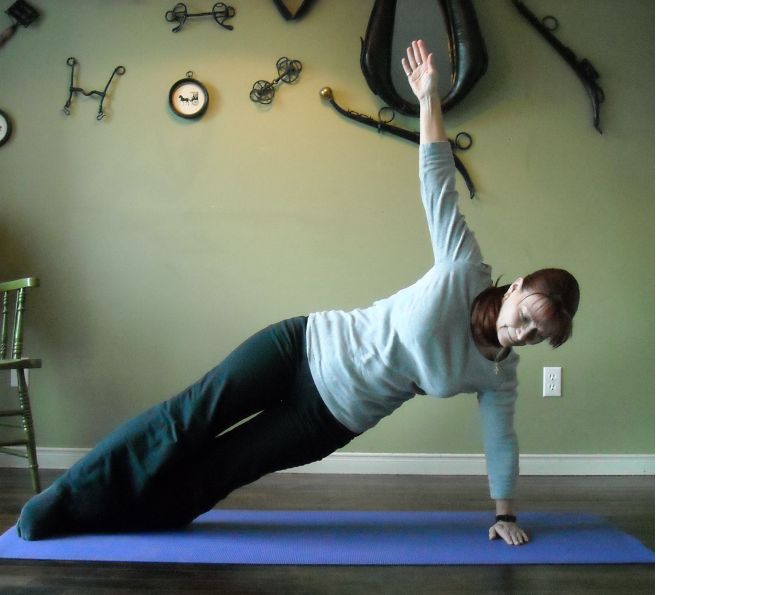
Raise one arm and side bend over, keep seat bones even — focus on keeping the seat bone on same side as raised arm, down. Hold for three breaths, then relax and repeat five times and switch sides. This exercise can be done with or without weight.

5. Torso Rotations on Chair or Stability Ball
Same position as above with or without wobble cushion.
Hold flex band (attached to stationary object) with fitness circle and rotate upper body, keeping seat bones even and pelvis neutral with hip bones pointing straight ahead. Hold for three breaths, repeat five times, then switch sides.
Related: Pilates for Every Equestrian
STANDING EXERCISES

6. Balance Board
Stand on balance board with knees slightly bent, shoulders down and relaxed. Draw belly button in towards spine to engage core. Hold flex bands like reins with elbows slightly bent.
- Elbows forward and back — both arms together, progress to alternating arms;
- External rotation — both arms together, progress to alternating arms.
Related: Correcting Crooked Changes

7. Standing Balance with Flex Bands
Stand with flex band around one leg, holding another flex band (attached to stationary object) like reins.
- Simultaneously move leg towards midline to activate adductors (inner thigh muscles), bend elbow and draw shoulder blades towards spine to pull flex band. Keep core engaged. Hold for three breaths and repeat five times, then switch sides;
- Simultaneously move leg backwards to activate glutes and hamstrings, bend elbow and draw shoulder blades towards spine to pull flex band. Keep core engaged. Hold for three breaths and repeat five times then switch sides;
- Simultaneously move leg backwards while reaching opposite arm forward.
Notes:
- For additional balance challenge when seated, put a small ball under each foot;
- If appropriate sit on a stability ball rather than a chair;
- Exercises can be done from a wheelchair;
- Use support pads to help posture and assist as necessary;
- Do not force joints to increase range of motion;
- Use light resistance bands to start and increase strength as appropriate;
- Additional modifications may be necessary;
- It is important to work with trained professionals and consult a doctor, physiotherapist, or other health professionals prior to starting any fitness program;
- All exercises and repetitions are guidelines only, each individual needs to gauge exercise appropriateness and adjust as necessary.
Resources:
- Professional Association of Therapeutic Horsemanship International
- Fit To Ride
- Equestrian Canada Para Dressage
- Canadian Therapeutic Riding Association
Related: Achieving Perfect Harmony with Your Horse: The Key to Effortless Riding
Related: Essential Exercises for a Classical Riding Position
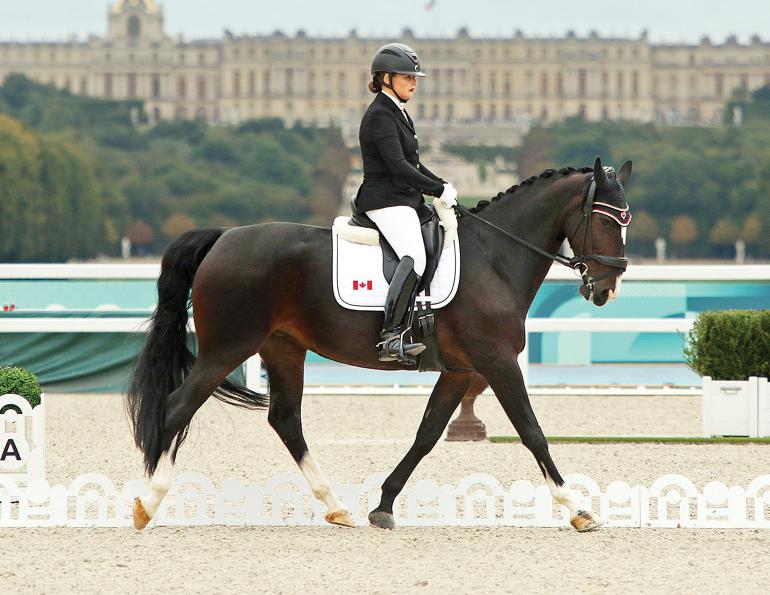
Main photo: Roberta Sheffield of Canada riding Fairuza in the Grade II Para Equestrian Individual Event at the 2024 Paralympic Games in Versailles, Paris. Photo: Alamy/Mark Davidson

Blogs & Podcasts

Articles by Trainer
Advertisement
Related Articles




Advertisement

Featured Stories


Advertisement
