

Groundwork vs Riding: Using Poles With Purpose

Updated:
April 24, 2026By Jec A. Ballou
The effects of ground poles vary significantly depending on whether they are performed in-hand or under saddle, at what speed, and in what volume. When poles are broadly recommended by veterinarians and trainers for rehabilitation or conditioning, riders are often left uncertain about the specifics of using them.
While some overlapping physiological outcomes do exist, the main difference to keep in mind is whether a horse needs exercises to improve its neurological and postural foundation versus its gymnastic strength. In general, groundwork best affects neuromuscular and postural outcomes, whereas ridden routines target actual strength. Put simply, groundwork improves movement patterns while ridden poles create strength, sustainability, and power within those patterns.
Let’s explore a little more clearly the different ways to condition using poles.
Groundwork vs. Riding
Ground poles offer the potential for key physiological gains including the following:
- Enhanced proprioception
- Awakening or fine-tuning neuromotor patterns
- Improved posture
- Improved rhythm
- Activation and toning of trunk muscles
- Mental alertness and focus
- Strengthening of locomotor muscles
Some of these benefits happen through groundwork while others rely on riding. Admittedly, a very strategic program that incorporates a variety of speeds and patterns makes it possible to access most of these changes using either groundwork or riding. But most horses require both methods to make all these changes. Groundwork, particularly when performed in a slow, methodical manner, mostly influences neurological and postural systems while ridden work stresses load-bearing and propulsive systems.
Related: Groundwork with Jec A Ballou
Related: The Best Cavalletti Exercises for Walk, Trot, and Canter
With groundwork, the potential exists for larger recruitment of deep stabilizer muscles without the compensation of carrying a rider. It can also result in greater sensory feedback and body awareness. Perhaps because it is frequently done at slower speeds, groundwork often reduces bracing in locomotive muscles, leading to a freer topline and mobility of the cervical spine.
In this way, groundwork pole exercises prepare the nervous system and stabilizing musculature to tolerate the greater forces introduced during ridden work. It improves how a horse moves before asking it to generate more force. It is important to note that, when done at the slow speeds required for proprioceptive gains, groundwork does not significantly increase muscle strength or size. It also does not prepare the horse for high-force athletic tasks. This requires the extra intensity that most commonly comes with riding.
With riding, the horse experiences extra loading of its axial skeleton, which leads to greater muscle fibre recruitment, especially in propulsive muscles. For instance, trotting over poles is often used to increase recruitment and strength of the thoracolumbar musculature in addition to the hindquarter muscles involved with forward movement.
While bearing extra weight on its back, the horse also experiences larger forces through the lower limb ligaments as the fetlock flexes downward with each step, which can improve resiliency. There are also higher cardio demands at ridden pole work when done at trot or canter, contributing to mitochondrial density and aerobic function responsible for sustaining high quality movement. While these extra demands on the gymnastic system are primarily positive, they carry negative consequences if the horse is not already at least moderately fit in the underlying muscle system before embarking on a program of ridden ground poles.
Exercises and Reps
Most rehab and early conditioning programs begin by asking the horse to walk in-hand over four to six sequential poles laid flat on the ground (Figure 1). A small number of reps, such as 10 or fewer, is preferred, with the intended outcome of the horse increasing sensory feedback from the limbs. This creates a foundation for organizing the whole body during movement. After approximately six sessions spread over two to four weeks, the next step is traveling in a straight line over six or more poles spaced at irregular distances.

Photo: Shutterstock/Mariait
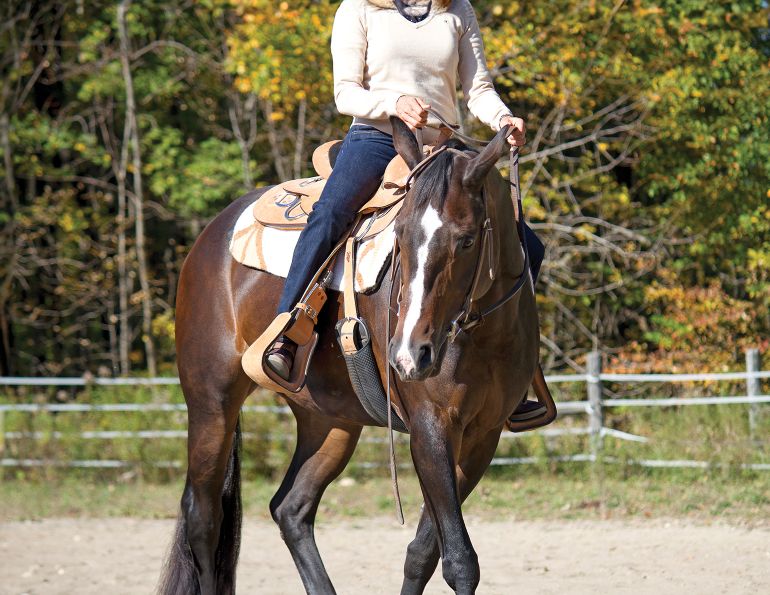
Potential gains here include neuromotor adaptability and reduced reliance on habitual movement patterns. From here, the horse progresses to raised poles and/or patterns that require minimal bending such as gentle serpentines over poles or labyrinths (Figure 2). Here the outcomes include recruitment of stabilizing muscles and improved balance. By this stage, horses have typically moved on to performing exercises for 10 to 20 reps versus a handful of reps in the early phase.
Related: Sidepass and Backing Obstacles: Benefits Beyond the Show Ring
Related: Creative Techniques for Productive Lunging

Photo courtesy of Jec Ballou
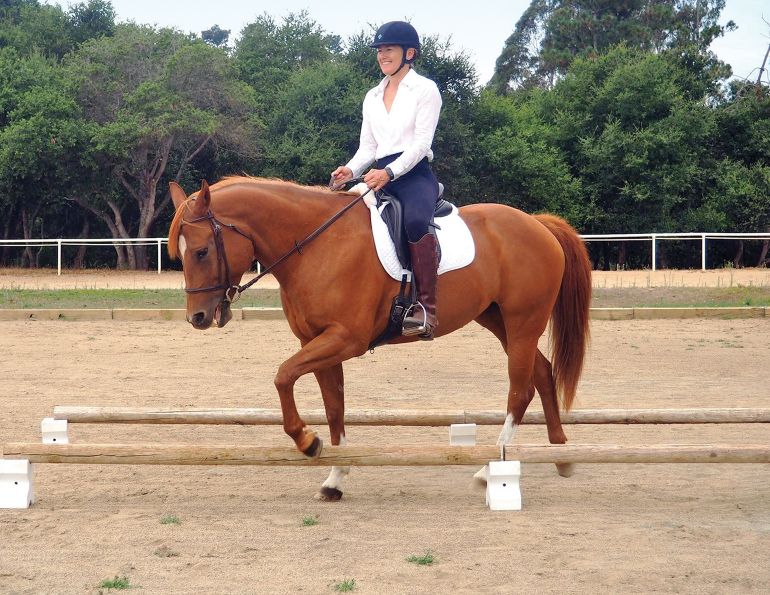
In ridden horses, a similar progression of exercises, albeit at greater speeds and under more load, ensues. Trotting straight lines over four to six sequential poles is a sensible starting point with 10 or fewer reps performed once weekly for two weeks. After this, poles can be raised, spaced in various formations, and the number of reps gradually notched up. Only after four or more consistent weeks of trotting poles on straight lines and gently offset lines should riders introduce patterns of continuous bending such as sequential poles on the arc of a circle (Figure 3). Curved lines and repetitive bending increase asymmetric loading and demand greater lateral stability — capacities that often lag basic postural and topline strength.

Photo courtesy of Jec Ballou
Check out this related video by Jec Ballou
When to Move On
A successful ground pole conditioning program relies on knowing when to add complexity or difficulty to the exercises, or when to shift from groundwork to riding. Above all, this progress is marked by the absence of compensations. The horse should maintain straightness without drifting and should lift and place his limbs deliberately rather than reactively. His or her topline remains elastic with the neck free to oscillate and the trunk supported without visible bracing. If rhythm falters, steps become rushed or irregular, or posture collapses, the level of difficulty should not be increased. Only when a horse completes an exercise with the same ease and coordination that he showed at a simpler level is he ready for progression.
Complexity should be layered gradually with only one variable increased at a time. This may mean adding a small increase in speed while keeping pole height and spacing unchanged, introducing a modest change in pole height while maintaining straight lines, or adding a small number of additional repetitions without altering the pattern.
The true benefit and success of pole work is reflected in carryover — the horse feels more balanced, organized, and responsive during everyday schooling. When ground pole exercises contribute to improved posture, steadier rhythm, and greater ease of movement away from poles, the horse demonstrates he has absorbed the training stimulus as intended.
Related: Crossing Poles In Stride for English and Western Riders
Related: Single Pole Exercises
Main Photo: Shutterstock/Olgaru79
Blogs & Podcasts

Articles by Trainer
Advertisement

Related Articles






Advertisement

Featured Stories


Equine Marketplace

Advertisement
