

Key Skeletal Developmental Milestones In Utero Can Predict Foaling Date

Updated:
March 24, 2026By Amy Young, UC Davis Center for Equine Health
Understanding equine pregnancy is essential to ensuring the best care for mares and foals. In particular, accurate foaling predictions are important for organizing surveillance in case the mare needs veterinary assistance. They also help breeders make decisions about future breeding dates, participation in competitions, and sales.
Gestation, the period between conception and birth, is highly variable in horses, ranging from 310 to 374 days (average 340 days). Equine fetal growth is linear in the second half of gestation, but factors such as breed, fetal sex, amount of daylight, the mare’s age, and whether she has been pregnant before affect gestation length.
With so many variables, it is challenging to predict exactly when a foal will be born, even when the breeding date is known. Research from UC Davis equine reproduction specialist Dr. Catherine Renaudin is providing tools to narrow in on foaling dates by measuring key milestones in bone development.
Related: Mare Age is the Primary Predictor of Foaling Success
Taking Measurements
Standardized fetal growth parameters including femur length, head circumference, and abdominal diameter are routinely measured by ultrasound in human pregnancies to predict fetal development and health. Similarly, Renaudin’s research has demonstrated that measurements such as the diameter of the head, diameter of the aorta, length of the femur, and volume of the eye directly relate to gestational age in horses.
Some parameters more accurately predict fetal age early in gestation, whereas others are better applied during mid- or late gestation. The challenge is that some of these structures are hard to measure or may be inaccessible by ultrasound due to the position of the fetus in the uterus. Similarly, although femur length and head measurements are highly correlated with the day of gestation, they become too large to measure by ultrasound after 220 and 300 days, respectively. As with other species, growth variability increases over time, so predictions are less accurate closer to the foaling date.

Drawing showing the position of the fetal lower limb in relation to the cervix of the mare in late gestation. Image courtesy of UC Davis
In combination, these measurements can predict gestational age within two to three weeks in Quarter Horses. Breed-specific tables need to be generated to expand use into other breeds.
Focusing on Foaling Date
More recently, Renaudin has been evaluating the relationship between the development of bones in the lower limb and foaling date using in utero ultrasonography. A study in Quarter Horses determined that the length of the long pastern bone (P1) was significantly correlated with days of gestation as measured in late pregnancy (more than 240 days of gestation).
Interestingly, P1 length was also correlated with the foals’ heights and weights when they were born. The shortest, lightest foal had the shortest P1 length in utero. In addition, it is possible to assess whether a mare is 10 or 11 months pregnant by looking at the appearance of P1. Research is underway to determine if this is consistent in other breeds.
Renaudin’s research provides evidence that the lower leg bones can be visualized by ultrasound at certain stages of gestation to provide accurate estimates of foaling dates since they appear in a reliable order. The lower condyle of the cannon bone becomes visible first, followed by the ossification centers of P1 and then P2 (short pastern bone), and finally by the ossification of the proximal sesamoid bones and navicular bone. Visualization of the navicular bone, which appears last, is the signature that lower leg bone development is complete in utero. This chronology is very comparable across breeds.
Renaudin is currently looking at the size of the navicular bone late in gestation. Results suggest that navicular bone length may be an additional tool to predict foaling time in healthy Quarter Horse and Thoroughbred pregnancies.
Related: Study Finds Ration Balancer Improves Colostrum Quality and Immunity Transfer in Foals

Ultrasound image of the lower limb of a A (above) 307-day old fetus showing P3 and P2 and the absence of the navicular bone (green arrow), indicating that lower limb bone maturation is incomplete; and B (below) a 319-day old fetus showing P3, P2, and the presence of the navicular bone (green arrow), indicating that lower limb bone maturation is complete. Images courtesy of Dr. Catherine Renaudin

Application
Standardization of fetal measurements improves foaling date prediction without known breeding dates. This is important for mares with potentially life-threatening medical conditions such as pre-pubic tendon ruptures or hydrops (excess placental fluid), in which labour is induced when foals are determined to be mature enough to survive outside of the uterus.
Measurement standardization also aids in evaluating a foal’s developmental status. If measurements determine that the fetus is growing normally for the stage of pregnancy, it is likely healthy. Those that indicate a small foal may signify health issues — such as placentitis (inflammation of the placenta), fetal abnormalities, maternal malnutrition, or the presence of twin foals — which should be referred to advanced reproductive care/neonatal services.
Fetal measurements can easily be obtained during routine veterinary appointments throughout pregnancy.
“All pregnant mares should be scanned during the last two months of pregnancy to ensure the foal is in the correct presentation for birth,” Renaudin suggests. “At the same time, we can look at the lower limb to determine if fetal bone development is appropriate for its age.”
Related: 10 Things To Know About Equine-Assisted Reproductive Techniques
Related: Equine In Vitro Embryo Production: Making Horses in a Lab
Related: Equine-Assisted Reproductive Techniques
Printed with the kind permission of the UC Davis Center for Equine Health. The UC Davic Center for Equine Health is dedicated to advancing the health, welfare, performance and veterinary care of horses through research, education and public service.
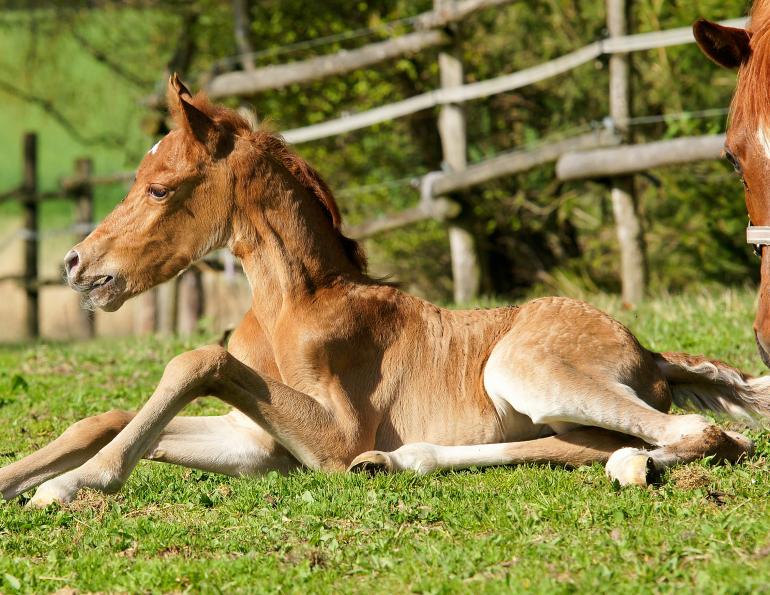
Main Photo: Shutterstock/Lucia L
Blogs & Podcasts

Advertisement

Related Articles


Advertisement

Featured Stories








Advertisement