

Biosecurity Strategy for Equestrian Events
Updated:
July 3, 2025By Maxwell H. Gluck, Equine Research Center
“Event Cancelled. Quarantine in Effect.”
No equine event manager or exhibitor wants to hear these words. However, the growing number of equestrian events, increased interprovincial and international equine movement, and the rising concentration of horses at individual events have all heightened the risk of infectious disease outbreaks and transmission.
Biosecurity, the measures taken to prevent pathogen entry and spread on a premises, is the key to protecting both equids and event venues from devastating disease outbreaks. There is no one-size-fits-all biosecurity plan for equine events as each venue event is unique. Thus, identifying and assessing biosecurity risks for the population of equids at the event and on event grounds are essential to developing the most effective biosecurity plan. The first step is performing a biosecurity risk assessment to identify the disease risk factors for the venue, event, and horse population.
Related: How Flies and Insects Impact Horses—and What You Can Do About It
Although the venue typically maintains a consistent footprint, weather can influence the entry and spread of disease agents. For example, strong winds in Canada, such as the Chinook winds in the west or powerful storm systems in the east, can carry pathogens or infected vectors (insects) onto or around a venue, increasing the risk of disease transmission.
Additionally, droughts almost certainly impact the availability of hay, resulting in the sourcing of hay for an event from further away. This sourcing of hay can potentially lead to the transmission of unfamiliar pathogens, toxins or insects, such as blister beetle, to a venue. Lastly, hot, humid days increase the likelihood of horses clustering under shade and/or utilizing communal water sources, which results in a higher risk of respiratory pathogen spread.
Related: Equine Infection Control: Strategies to Prevent Transmission
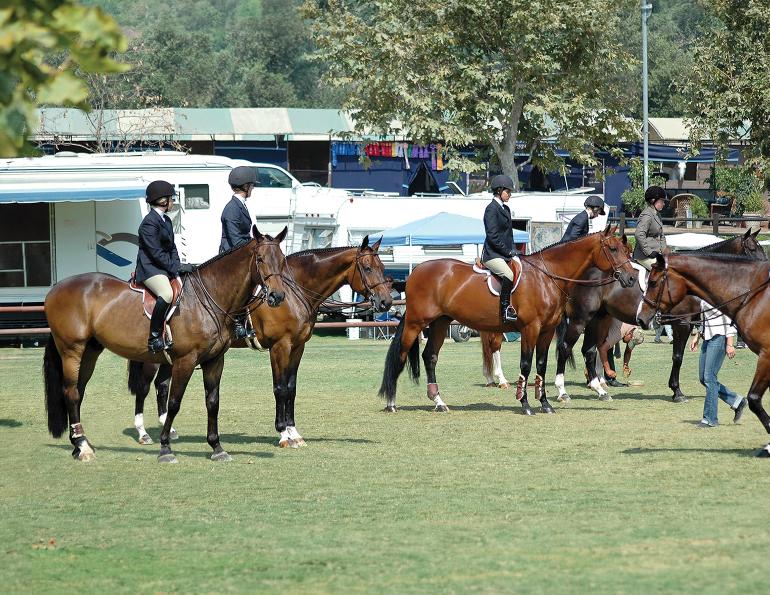
When looking at equestrian events, there is no cookie-cutter event biosecurity plan for the venue. Each event is unique with regards to stabling and competition plans for the venue grounds. Events involving multiple disciplines may designate a day or consecutive days for each discipline, while others may have all disciplines on the venue grounds at the same time. Thus, a disease outbreak occurring in one discipline would more significantly impact a show that includes many disciplines on the grounds, especially if horses of various disciplines are housed together.
Another aspect to consider is that each discipline has different horse management and competition practices that could impact disease risk. For example, at some Western events it is more common to see horses tied along the fence outside the competition arenas. At another event, a single nose rag might be used to wipe several muzzles outside a show ring. During an event, the amount of horse-to-horse contact on the grounds can also impact these outcomes.
Once a risk assessment has identified potential points of disease entry and transmission, the appropriate biosecurity measures can be determined to mitigate the risk. The event manager, in consultation with the event veterinarian, should compile these biosecurity measures into a written biosecurity plan for the event. Some basic concepts to consider in a biosecurity plan include healthy equine entry requirements; limiting horse-to-horse contact; limiting human contact to essential personnel; avoiding the sharing of equipment unless it has been cleaned and disinfected between uses; and monitoring the health of all equines on the premises. Entry to the venue should be restricted to horses accompanied by an owner-signed health declaration, which attests that the horse has been monitored for at least three days prior to arrival, with twice-daily temperature readings below 38.5°C (101.5°F) and no observable clinical signs of disease. Furthermore, the plan should require and verify proof of vaccination for equine influenza and equine herpesvirus-1 within the prior six months.
Unfortunately, even with these measures implemented, horses may still develop an infectious disease at an equine event. Therefore, prompt identification and isolation of the sick horse limits disease spread beyond the first case. Identification of the sick horse requires protocols that call for all horses on the grounds to be monitored for any signs of illness or fever, and if present, be reported to a veterinarian. If the veterinarian suspects an infectious disease case, that horse must be immediately isolated in appropriate isolation stabling. Oftentimes, space is limited on event grounds and appropriate isolation is not possible at the venue. These event grounds must identify a place to isolate off-site in advance, as finding a place at the time of identification of a sick horse delays the isolation and increases exposure risks to all horses on the grounds. Some options for off-site isolation include empty fairgrounds, stables, or fields with run-in sheds.
Related: Equine Biosecurity: Preventing the Spread of Infectious Disease
Once an infectious disease has been confirmed, identifying any exposed horses to monitor can be a significant challenge, especially if the facility or event has many potential avenues for horse-to-horse or human-to-horse contact or sharing of equipment. Horses that can touch over the tops of stalls or through the bars, or that are loped in an arena for an extended time close to another horse, have an increased potential for the spread of respiratory pathogens. However, it is often difficult to identify all horses, people, and equipment that have touched the affected horse. Thus, it becomes important to have protocols in place for all those handling multiple horses to prevent fomite (inanimate objects, such as buckets, rags, tack, etc.) transmission of pathogens.
Proper cleaning and disinfecting protocols are essential to decrease the risk of infectious disease agent spread. Stalls and common areas should be regularly cleaned and disinfected with a disinfectant appropriate for the surface. For example, bleach is inactivated by organic material, thus it is ineffective in a stall that has manure stains covering the surface. Metallic surfaces, like bars in a stall, require a noncorrosive disinfectant to prevent degradation of the surface. Venue management should consult a veterinarian to determine the most effective disinfectant(s) for the various surfaces on their grounds.
Ultimately, identifying the disease risk factors for the specific event, developing a written biosecurity plan, and implementing a few key biosecurity measures can protect the horses on the event grounds as well as protect the show from potential cancellation and quarantine due to an infectious disease agent.
Related: 10 Things You Might Not Know About Equine Biosecurity
Related: Can Humans Catch Illnesses from Horses?
Photo: AdobeStock/Clarence Alford
Blogs & Podcasts

Advertisement

Related Articles


Advertisement

Featured Stories



Advertisement
